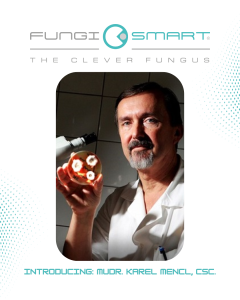
One of our researchers explains I’d like to find out for myself how FungiSmart® works, why it is completely safe and what the applications. We would like to suggest To MUDr. Karel Mencl, CSc.
What inspired FungiSmart?
“A happy coincidence. A colleague working on the packaging line for the agricultural product containing Pythium Oligandrum had the contents of a sachet spill into her work shoes. At the time, she was suffering from acute interdigital mycosis and was not using any chemical antifungal treatments.
After a few days, her condition improved considerably and she eventually recovered without the use of antifungal medication. She suspected a link with Pythium Oligandrum and subsequently tried it on her husband, who also had interdigital mycosis. He, too, recovered without any chemical treatments. This colleague shared her findings with the company’s management, who decided from that point onwards to focus their research on curing fungal skin infections in humans as well.”
Could you explain how Pythium Oligandrum
combats other fungi?
“In a damp environment, Pythium Oligandrum detects the presence of other microscopic fungi via chemotaxis. It directs its mycelial fibres towards these fungi and secretes a range of enzymes and ferments into the environment. Upon contact with the target fungus, these enzymes become more active, enabling Pythium Oligandrum to penetrate the fungus’s hyphae. It then extracts nutrients from the target fungus until it is completely eliminated.”.
In sufficiently moist conditions, Pythium oligandrum forms specialised structures known as zoosporangia, within which zoospores develop. These zoospores are motile thanks to two flagella and, when mature, are released into the environment, where they search for food – other microscopic fungi. When they find a fungus, they transform into penetrating filaments, neutralise the host fungus and form a new PO individual. If no food is found, the zoospores form cysts. After some time, they reactivate in search of food, once again producing enzymes and ferments.”
Are there any risks or limitations associated with the use of FungiSmart®?
“FungiSmart® can be used universally to treat superficial fungal infections, regardless of age, gender or general state of health, including in immunocompromised individuals. As Pythium Oligandrum is a strict mycoparasite, it cannot grow or multiply at the body temperature of humans or other mammals. This means that it cannot penetrate human tissues. It has been successfully tested on fungal infections of the skin and nails, suppurative wounds (such as venous ulcers and pressure sores), and on the oral mucosa.”
How does FungiSmart® differ from conventional antifungal agents?
FungiSmart® utilises Pythium Oligandrum, an organism that naturally combats harmful fungi. Rather than acting immediately, as with chemical alternatives, it employs a gradual process whereby fungi are “depleted” as a food source. The product is completely non-toxic, hypoallergenic and free from resistance issues, ensuring safe and repeated use for all users.
What makes FungiSmart® unique?
Instead of chemical control, FungiSmart® uses a natural approach based on a predator-prey mechanism. Pythium Oligandrum feeds on harmful fungi, thereby disrupting their growth. The product is suitable for universal use, safe for humans and animals, and prevents resistance due to its biological mode of action.
What did you find most interesting about the product development process?
“Researching FungiSmart® and developing biopreparations containing it was both fascinating and demanding. Thanks to the chance discovery of FungiSmart® in work boots, significant progress was made in the field of biocosmetic preparations.”
What was the most challenging part of the development process?
“The biggest challenge was to convince the professional community that FungiSmart® is a specialised mycoparasite. We demonstrated this through scientific studies. Another major challenge was optimising laboratory methods to ensure reliable and reproducible results. Both were ultimately successfully resolved.”
Frequently Asked Questions
- What is Pythium Oligandrum?
Pythium Oligandrum is a natural microorganism, also known as a ‘mycoparasite’, which safely and effectively combats harmful moulds and yeasts. It feeds on pathogenic moulds without harming humans, animals or plants. Once the harmful organisms have been eliminated, Pythium Oligandrum disappears of its own accord.
- Is FungiSmart safe for me, my family and my pets?
Yes. FungiSmart has been extensively tested and meets strict European safety and efficacy standards. It targets only harmful moulds and yeasts and does not affect healthy skin or mucous membranes.
- Could I have an allergic reaction?
Allergic reactions to Pythium Oligandrum are extremely rare. It is safe for children and vulnerable groups. If you have sensitive skin or a history of allergies, it is advisable to test it on a small area of skin first.
- How does FungiSmart work?
The product uses Pythium Oligandrum to identify and combat harmful fungi and yeasts. It breaks down their cell walls, feeds on them and restores the natural microbial balance, without damaging healthy tissue.
- How do I know that FungiSmart has been properly tested?
FungiSmart is the result of 14 years of scientific research and has been tested in several clinical trials and laboratories across Europe. It complies with all EU standards and has been approved by independent experts.
- Are there any known side effects?
No serious side effects have been reported. In rare cases, temporary, mild irritation may occur.
- Can I use FungiSmart alongside other treatments?
Yes, provided that the other treatment is not antifungal or does not have antifungal properties. If in doubt, consult your healthcare provider.
- Is FungiSmart environmentally friendly?
Yes. It is completely biodegradable, contains no chemical residues and has no harmful effect on the environment.
- Where can I find more information about the science behind FungiSmart?
On our website, you will find summaries of scientific publications and links to further resources.
- How does FungiSmart work on other organisms?
In damp environments, it detects harmful moulds and yeasts via chemotaxis, extends its mycelial fibres, releases enzymes and penetrates the target fungus. It does not cause resistance, unlike chemical agents.
- Are there any risks or limitations?
FungiSmart cannot grow or multiply on the human body. This is because the human body’s natural microbiome does not provide a suitable breeding ground for Pythium Oligandrum.
- How does FungiSmart differ from traditional antifungal treatments?
It is a natural mycoparasite that consumes moulds and yeasts; it acts as a predator-prey mechanism, is non-toxic, hypoallergenic and safe for repeated use. Furthermore, there is no risk of resistance and it can be safely dosed.
- What results have been observed in clinical trials?
Medical studies confirm its effectiveness and safety. Results and data are available on our website.
- How should I store FungiSmart?
Room temperature (15–25°C). Store in a dry place and keep tightly sealed. Protect from moisture to prevent activation.
- What is the shelf life of FungiSmart?
Depending on the form (tablet, powder, oil), the shelf life ranges from 6 to 24 months after opening. The expiry date and batch number are printed on the packaging.
- What if my question isn’t answered here?
Please contact us at info@fungismart.com. We always provide a scientifically substantiated answer.
FungiSmart is not just another product, but a new approach.
A natural, scientifically-backed addition to the healthcare of tomorrow, ready for use today.
Would you like more information? Please email wesly@hfllaboratories.com or call 013 455 1749